This activity gives links to some external resources (2 simulations and 1 video) that allow students to explore circle trigonometry. There are no prompts and nothing specific to turn in.
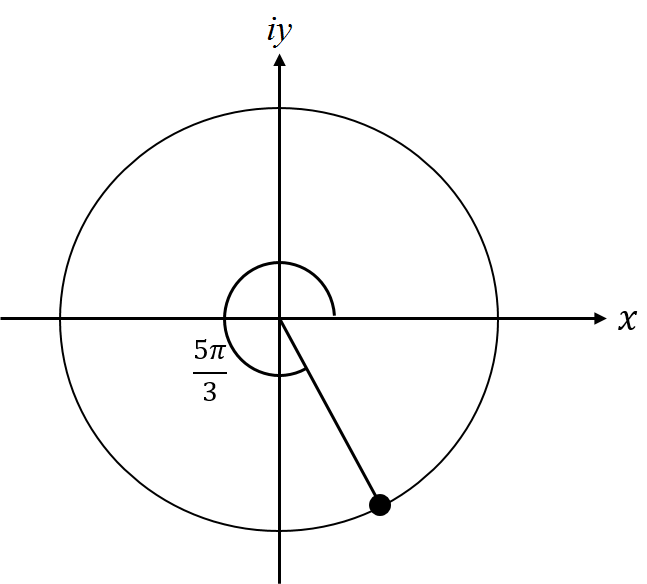
Find the rectangular coordinates of the point where the angle \(\frac{5\pi}{3}\) meets the unit circle. If this were a point in the complex plane, what would be the rectangular and exponential forms of the complex number? (See figure.)
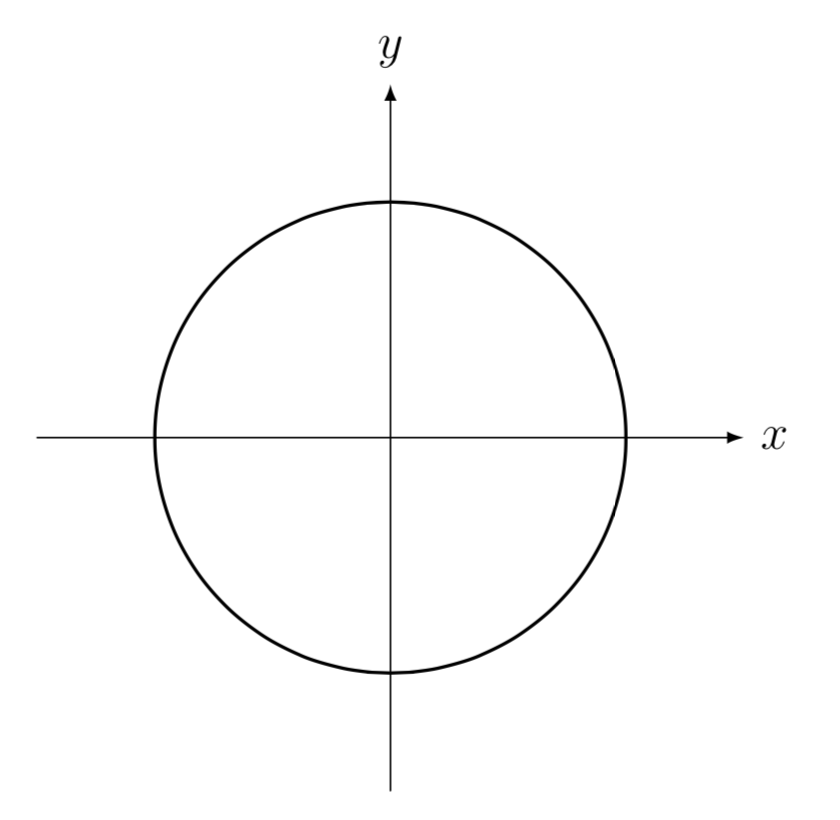
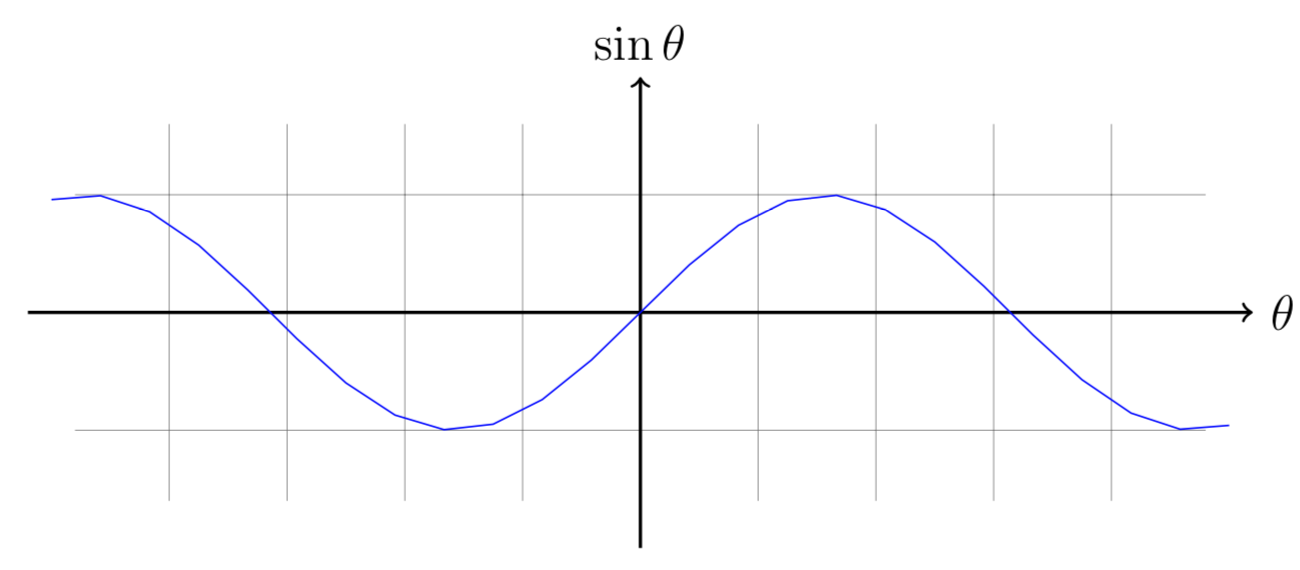
On the following diagrams, mark both \(\theta\) and \(\sin\theta\) for \(\theta_1=\frac{5\pi}{6}\) and \(\theta_2=\frac{7\pi}{6}\). Write one to three sentences about how these two representations are related to each other. (For example, see: this PHET)
List the properties that define a central force system.
Calculate a reduced mass for a two-body system and describe why it is important.
Use the solution (algebraic or geometric) to a reduced mass system to describe the motion of the original system.
Describe the role that conservation of energy and angular momentum play in a central force system. In particular, where do these properties appear in the solutions of the equations of motion?
Use an effective potential diagram to predict the possible orbits in a central force system: which orbits are bound or unbound? which are closed or open? where will the turning points be?
Describe the energy eigenstates for the ring system algebraically and graphically.
List the physical measurables for the system and give expressions for the corresponding operators in bra/ket, matrix, and position representations.
Give the possible quantum numbers for the quantum ring system and describe any degeneracies.
For a given state, use the inner product in bra/ket, matrix, and position representations, to find the probability of making any physically relevant measurement, including states with degeneracy.
Use an expansion in energy eigenstates to find the time dependence of a given state.
In this unit, you will explore the most common partial differential equations that arise in physics contexts. You will learn the separation of variables procedure to solve these equations.
Motivating Questions
How are partial differential equations (PDEs) different from ordinary differential equations (ODEs)?
What new kinds of physics can we learn from solving partial differential equations?
What can we learn about physics and geometry from the separation of variables procedure?
In this unit, you will explore the electrostatic potential \(V(\vec{r})\) due to one or more discrete charges and the gravitational potential \(\Phi(\vec{r})\) due to one or more discrete masses. How does the potential vary in space? How do equipotential surfaces and the superposition principle help you answer these questions graphically? How does the value of the potential fall-off as you move away from the charges? How do power series approximations help you answer these questions algebraically?
Describe the important similarities and differences between the electrostatic potential and the gravitational potential.
Sketch the potential due to a small number of discrete charges or masses, showing important regions of interest and qualitatively depict the correct spacing between equipotential surfaces (or curves).
Compute power and Laurent series expansions from a real-world problem using simple, memorized power series.
Truncate a series properly at a given order by keeping all the terms up to that order and none of the terms of higher order.
Discuss in detail the relationship between the graphical, algebraic, and power series representations of the potentials.
Students move their left arm in a circle to trace out the complex plane (Argand diagram). They then explore the rectangular and exponential representations of complex numbers by using their left arm to show given complex numbers on the complex plane. Finally they enact multiplication of complex numbers in exponential form and complex conjugation.
In this small group activity, students draw components of a vector in Cartesian and polar bases. Students then write the components of the vector in these bases as both dot products with unit vectors and as bra/kets with basis bras.